


PSAROKOKALO MAGAZINE, ANIMATION
THE CITY AS A LIVING ORGANISM
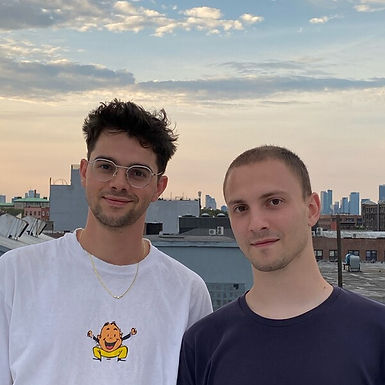
A conversation with Jack Wedge and Will Freudenheim on Acid City, ecological collapse, and the architecture of memory.
“Each person has an ocean of memories, experiences, traumas, and victories that we could never even dream of. Sometimes just talking to someone... can pierce through the noise of everyday life.”
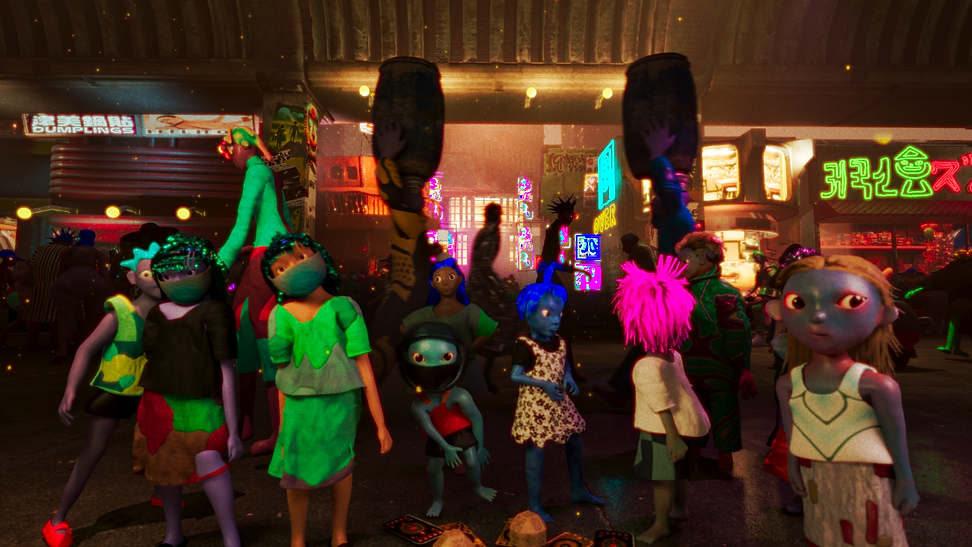
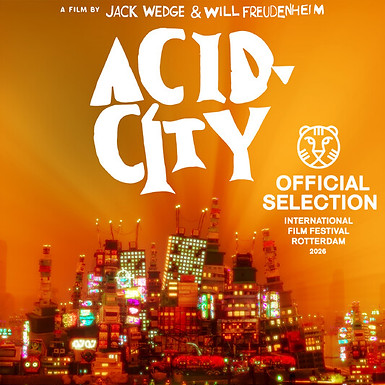
In contemporary moving image work, dystopian environments usually function as wallpaper—high-resolution backdrops designed to service a hero's arc. Acid City, however, inverts this conventional hierarchy. At its core lies an imaginary metropolis afloat on a vast, acidic ocean, treated not as a set piece, but as the ultimate, living protagonist of a hybrid cinematic experience. Directed by Jack Wedge and Will Freudenheim, the film blends digital topography and animation with raw, authentic interviews gathered from pedestrians, scientists, and workers across the streets of New York City.
Over the course of an extended conversation regarding the genesis, evolution, and technical structure of this urban ecosystem, the two creators uncover the layers of a film born out of the existential anxieties of our climate era.

The City as a Living Organism
Acid City treats an imaginary metropolis afloat on an acidic ocean as a fully realized protagonist rather than a mere backdrop. How did you approach world-building an environment that merges physical peril with a resilient, self-sufficient culture, and what were the architectural or atmospheric inspirations behind it?or atmospheric inspirations
behind it?
Jack Wedge: This approach took a long time to develop and get right. The first script of Acid City was completed in July 2022. At first the film was focusing on a specific protagonist, going on a journey into the city. Several months into working on that version we came to the solemn realization that the movie wasn't about what we wanted it to be about. That was hard. We slowly decided that we weren’t going to finish that version, instead shifting focus away from making a movie about one character to making a movie about the city itself. I remember feeling intense amounts of stress and failure during this time period. It felt like giving up since I really believed in that first movie and had already poured an untold number of hours into making it a reality. But it wasn’t working and that was clear.
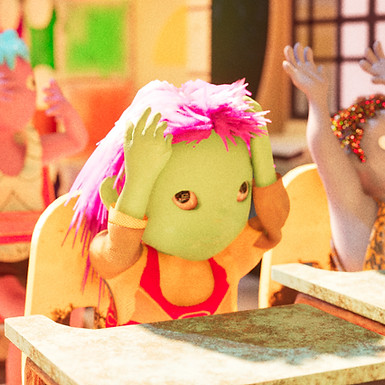
There are a lot of things from this first version that still ended up in the movie. We had already created a compelling montage sequence of a water taxi entering the city and exploring the canals, which was ultimately taken apart and redistributed throughout the film. The first version also featured a little gang of kids acting as a sort of guide to the protagonist. They were always intended to be unscripted—which, funny enough, was inspired by a sample from a Boards of Canada song that I kept playing on repeat while writing the script. I had started interviewing some of my friends' kids or younger cousins to get dialogue for the kid characters. That was the genesis of the interview idea.
Throughout the 2020s, reality increasingly felt more like science fiction to us: one-third of Pakistan flooded, displacing millions; Los Angeles burning down; each consecutive year blowing past the previous as the hottest ever recorded in human civilization. The world falling apart around us made us further realize this movie couldn't be made in a vacuum. We needed to document the world around us and bring it into this animated film. Movies like Mikhail Kalatozov's Soy Cuba—where Cuba herself narrates the story—or Chris Marker's Sans Soleil showed us how an environment acquires memory, awareness, and interests, transcending any single protagonist.
The film blurs the lines between fiction and documentation by weaving real-world interviews collected across New York City—ranging from pedestrians and water scientists to emergency responders—with invented characters. How did you curate and stitch these disparate voices together to form a cohesive, believable social fabric for a fictional city?
J. W. : When we first started thinking about incorporating interviews into the film we were still working on the original narrative version. There was a point where we were thinking about breaking up the narrative with interviews. We weren’t sure how we were going to fit everything together without making the movie too long. Shifting to an entirely separate interview based documentary version of Acid City was a gradual process. I remember discussing with Will about what we should name this interview version. Acid City Interviews? Doesn’t hit as hard… then we slowly just realized yea.. what about just calling the documentary version “Acid City”? That had a much better ring to it. Then we thought, maybe this documentary version is a much better idea. Again, this was a painful process leading to a better outcome. There was so much discovery that went into the process of making this film, technically, emotionally, narratively.
In November 2023, I started wandering around different neighborhoods in New York with a field recorder. I really had no idea what I was doing. I interviewed dozens of people. Approaching strangers with a microphone in NYC is hard. I would ask people different questions depending on who I was talking to. I would ask people broad questions about NYC, for example; “Hi, I’m making a documentary about the people of NYC. Could you tell me a little bit about your relationship to the city? How has the neighborhood that you’re from changed since you were a kid? Tell me about growing up in NYC. What’s your favorite thing to do?” I was interested in the concept of home and what that meant to people and how that was changing. I’ve been thinking about heritage recently in connection with the climate crisis since people are literally losing the places where they grew up. That’s a big theme in Acid City, “a city eaten by the rain and swallowed by the ocean.” I would try to get people to tell me stories. One woman told me she OD'd on crack and woke up in a morgue because everyone thought she was dead.
“Throughout the 2020s reality increasingly was feeling more like science fiction to us... The world falling apart around us made us further realize this movie couldn't be made in a vacuum”
I interviewed people in Jamaica, Queens, the Upper East Side, Central Park, Harlem, the Financial District, Chinatown, Bed-stuy, Prospect Park, Seward Park, Two Bridges. I interviewed kids playing in the park, teenagers getting out of school, two old guys hanging out outside of a bodega. I interviewed a lady running for city council who had truly crazy policy ideas. I interviewed people from all walks of life. Sometimes I would meet someone on the street and then arrange to sit down and chat with them the next day. I interviewed an Amazon delivery truck crew. I interviewed a security guard outside a church, a woman at the laundromat. I interviewed my friend Raheem at Chess Forum. I interviewed a group of drunk women on Canal street. Some of these interviews are anonymous and some of them have their names in the credits.
We immediately had a problem in the edit which was “things were feeling too random”. The interviews were all disconnected. None of them really had anything to do with one another. There was no through line or structure. So I started writing a script around the best interviews I had taken. This is where the film crew visiting the city idea came from. The narration, again taking from Marker and Herzog’s work, helped give the movie a spine, a backbone. We then cut the movie into 5 sections: Arrival, Heat, Water, God, Night.
This is where we also started to invent fictional characters to mix together with the real. We were very careful about this. I really wanted to make it so the audience couldn’t tell which was which. The fictional characters in the film all had lines that were obviously much more specific about Acid City itself. I also tried to let the actors who played these fictional characters improvise as much as possible so we could mix what I had written with what they wanted to talk about as well.
I would start out by interviewing the actors similarly to how I would approach someone on the street and then after that I would ask them to read a few lines. I did this with strangers on the street as well. I met a man in Harlem named Louis J. I heard him speaking to a lady at a market and fell in love with his voice. He had two big pit bulls and a baseball jacket with looney tunes characters on it. I started chatting with him and got his number. A couple days later we met up on Lenox Street and had a long conversation which I recorded. I asked him to read a few lines from the script and he started to cry. The lines were “I have so many memories. When I come here I think of my parents, I think of my mother.” He told me his mother had just passed away last year. It made me think about all the strangers we walk by on the street everyday. Each person has an ocean of memories, experiences, traumas, and victories that we could never even dream of. Sometimes just talking to someone, asking them a simple question like “how is your day?” can pierce through the noise that is transaction, routine, work, struggle, and the deluge of everyday life. I stayed in touch with Louis J. The last time I chatted with him was January 2025.
“We were making a linear film, but a lot of the way that we constructed it was closer to building a world first and then discovering the movie inside of it”
The Intersection of Animation and Game Design
Jack’s background in animation and Will’s expertise in game design, virtual environments, and experimental systems clearly shape the film's DNA. How did your respective practices influence the visual and structural language of a documentary format?
Will Freudenheim: Jack and I came to the movie from pretty different backgrounds. Jack is an animator and filmmaker, and I had been working more in games, virtual environments and real-time systems. I think Acid City ended up somewhere in between those approaches. We were making a linear film, but a lot of the way that we constructed it was closer to building a world first and then discovering the movie inside of it.
A big part of that process was procedural. Jack would hand-craft individual buildings, objects, signs, pieces of infrastructure and architectural elements, or character parts and outfits, and I would design systems that could distribute them, modify them, recombine them and produce variations. Instead of building every shot as its own isolated set, we could create much larger environments out of those pieces. We would build an elaborate section of the city, then walk around inside of it almost like we were location scouting a real place. We might find a particular alleyway, rooftop or canal that suggested a scene, and then stage one of the character performances we had animated within that location.
That meant the process was always a mixture of discovery and careful placement. Some things were designed very specifically for a particular moment, while other things emerged from systems that produced combinations we hadn't completely anticipated. We could move through a neighborhood and find an angle or arrangement that suddenly felt right. Then we could go back in and alter it, add details, move buildings around, change the density or reshape the environment around the shot. There was a constant back-and-forth between constructing a system and responding to what the system produced.
That way of working comes a lot from games. In games you usually have to think beyond the frame because the player can move around. You are building spaces rather than individual compositions, and those spaces need enough internal logic and variation to hold up from different viewpoints. Even though Acid City is ultimately a film, we approached many of its environments in that way. The world came first, and then we found the locations within it where scenes could happen.
Jack's animation practice kept that procedural approach from becoming too rigid. The underlying systems might generate the larger structure of the city, but the individual elements still had his hand in them. We didn't want procedural generation to mean generic repetition. It was more a way of taking things that had been carefully designed and allowing them to proliferate, transform and form relationships with each other at a larger scale.
We were also very conscious of the camera once we entered those worlds. A lot of virtual production and game-engine imagery can feel like a camera floating through a perfectly controlled space. Documentary cameras behave very differently. Sometimes they miss things, arrive late or get distracted. They observe something happening at a distance. Once we had these larger environments to move through, we could treat the camera more like a documentary crew entering a real place, finding positions inside it rather than designing the entire world around a single predetermined shot.
The Pragmatic and the Spiritual
You examine the city's relationship to extreme heat and water through both a practical and a spiritual lens. When building a speculative environment to reflect our current climate anxieties, why was it vital to include the spiritual or ritualistic dimensions of survival alongside hard science?
W. F. : One thing we didn't want to do was imagine climate adaptation purely an engineering problem. Obviously there are very practical questions in Acid City about water, heat, architecture, and infrastructure. How do you collect water? What happens when the systems that people previously depended on stop working? We were interested in all of that, and we talked to people who actually work with water and emergency systems because we wanted that side of the city to have a material reality.
But when people live within an environment for generations, their relationship to it doesn't remain purely practical. It becomes cultural. They develop habits, stories, superstitions, ceremonies, jokes and ways of understanding what is happening around you.
That felt especially important because climate change is already producing this strange collision between enormous scientific systems and very intimate experiences. We understand climate through graphs measuring fractions of degrees and parts per million, but we actually experience it through a childhood beach disappearing, a tree dying, a winter that doesn't feel like the winters you remember, or a street that now floods every year. Those forms of knowledge exist at the same time. We wanted the people in Acid City to have scientific explanations for their environment, while also sharing ways of living emotionally and culturally inside it.
, one right inside the scene and one able to stand slightly outside it, became a really useful way of working.
There is also something very old about the human relationship to weather and water. For most of human history those forces have been understood through ritual, religion, folklore, and myth. Modern infrastructure can make us feel separated from that relationship because water arrives invisibly through pipes and temperature is controlled by a thermostat. In Acid City those systems have become unstable again. People are forced into a much more direct relationship with their surroundings.
For us, the spiritual elements are another form of adaptation. If you are imagining a city that has survived for generations under completely altered environmental conditions, people wouldn't only invent new machines or infrastructures. They would invent new meanings. They would develop traditions around the conditions that structure their lives. That was necessary for the city to feel like a distinct culture rather than a disaster scenario.

New York as a Subtext
Given that the film uses real interviews gathered across New York City to construct a climate-altered metropolis, how much of contemporary NYC's actual infrastructural and psychological weight bled into the DNA of Acid City?
J. W. : Acid City is composed of many real cities all across the world, but New York City is the main one. New York is one of the most diverse cities in the world. We wanted Acid City to reflect that. We wanted to convey a sense of pride and dignity in the city. The movie is about community and resiliency. While we were working on the movie we started to think of Acid City as our own home, a place we loved, cherished and wanted to protect.
Many different New York City neighborhoods both influenced the film and are directly present in Acid City. A specific example is the outdoor market that is underneath the Manhattan bridge. I took photoscans of the stone arches and plywood bins that are full of all sorts of different produce. That became the Acid City Night Market. I took photoscans of newspaper stands, pipes, mailboxes, street signs, and all sorts of city infrastructure. These were blended with other assets which we modelled and textured from scratch using blender and substance painter. This process lent to the feeling of Acid City being partially real, partially fiction. To this day I will notice something about a particular building or area and still feel the impulse to take a picture of it so that I can include it in the movie.
Author Soultana Koumoutsi