


PSAROKOKALO MAGAZINE, DOCUMENTARY SPECIAL, ARCRHITECTURE & ENVIRONMENT
THE MEMORY OF WATER
On the Disappearing Seascapes of Mumbai and the Metaphysics of Infrastructure
An Interview with Sudarshan Sarjerao Sawant
“Bridges are not merely constructed to span distances; frequently, in forging a new passage, they sever us from everything that came before.”

To walk the perimeter of modern Mumbai is to witness an aggressive, unrelenting act of terrestrial expansion. The city—once an archipelago of seven distinct islands bound by the ebb and flow of the Arabian Sea—is rapidly being entombed beneath concrete causeways, land reclamations, and towering spans of cable-stayed infrastructure. For the Koli, the indigenous fishing community that has inhabited these shores for generations, this relentless march of progress represents something far more devastating than mere gentrification: it is the systematic burial of an entire way of being.
In his remarkable documentary short Lost Songs of Sundari, which was recently honored with the Best Film – Architecture & Environment Award at the 18th Psarokokalo International Short Film Festival, director Sudarshan Sarjerao Sawant approaches this ecological rupture not through the dry lens of civic critique, but as an elegiac ghost story.
Sawant, a former innovation engineer and FTII-trained sound designer, structures his narrative around the Koli myth of Sundari—a legendary ferryboat and its ferrywoman who once guided travelers across the creeks long before modern engineering severed the shoreline. Through a delicate tapestry of three generations (a woman who preserves the myth, an aging ferry operator negotiating a dying trade, and a child inheriting a paved horizon), the film turns an intimate eye toward the quiet violence of urban expansion.
We sat down with Sawant to discuss the sonic texture of loss, the politics of connectivity, and how cinema can preserve the fragile memories embedded in water.ure of grief, the creative power of isolation, and what it truly means to step into the "wild."

THE SOUNDSCAPE OF ERASURE
You arrived at filmmaking through a sophisticated background in engineering and award-winning sound design. In a film that deals fundamentally with the replacement of fluid ecosystems by solid concrete, how did sound become your primary instrument for evoking what has vanished?
Sudarshan Sarjerao Sawant: I consider myself a sound-driven filmmaker at heart. When a sound and an image hit the exact right resonance together, they evoke a visceral reality that visual texture alone can rarely achieve.
Lost Songs of Sundari did not begin with a written script; it began with listening. I spent months sitting with members of the Koli community, listening to their oral histories, their quiet observations, and their grief over the shifting coastline. Those conversations formed the backbone of our sound architecture. A child casually mentioning that "fish can hear you from beneath the ocean," juxtaposed against the rhythmic, thunderous thrum of sports cars racing across the new Sea Link overhead, became our primary acoustic coordinates.
I’ve always been captivated by the hypothesis that water holds memory—that liquid bodies retain an imprint of everything that has transpired within them, even as humans alter their courses. Throughout the film, we woven in subterranean aquatic frequencies, micro-textures of marine life, and ambient underwater resonance. It operates as an invisible parallel reality. Even when the camera shows only dry concrete and rising pillars, the audio track insists that the sea—and everything it once carried—is still present, bearing witness.
In your director's statement, you mention the need to reconnect with the primal, "wild" female nature that has suffered oppression and violence. How do you define this "wildness"? Is returning to instinct the only path to healing the suppressed trauma of an abusive relationship?
E.V.: A woman’s "wildness," as I perceive it, has nothing to do with violence—unless her life is threatened. Essentially, the "wild" woman is the awakened, wise woman; the one who connects with her heart and, through that connection, rediscovers her lost intuition and her freedom—so severely suppressed throughout the centuries.
MYTH AS A STRUCTURAL AXIS

The festival jury—specifically architects Dionisis Sotovikis and Pétur Jónsson—singled out your use of the Sundari myth as an "elegant structuring device" for examining the human cost of infrastructure. How did you balance ancient folklore with the brutalist reality of land reclamation?
S.S.S.:The myth of Sundari was revealed to me organically during my time with the Koli elders. The more I sat with her story, the more I realized it wasn't a nostalgic fable, but the emotional spine of our present condition.
I structured the myth across three cinematic acts: the emergence of Sundari, the crisis, and the aftermath. I deliberately fractured this timeline, placing the raw, unpolished reality of contemporary urban development directly into the center of the mythic arc.

By having an elder Koli woman narrate the folklore in an intimate, almost conversational cadence, her voice bridges the gap between eras. She doesn't speak of Sundari as a figure buried in antiquity; she speaks as though Sundari were drifting just offshore in the morning fog. The myth does not offer an escape from urbanization—it becomes an analytical framework through which we measure what the city has sacrificed.
THE ANATOMY OF "PROGRESS"

In his jury statement, CCA Montreal’s Francesco Garutti observed that your film captures the "dramatic friction between new forms of urbanization damaging ecosystems across the world and the values of a community living by the sea." What is the true cost when infrastructure connects two geographic points while disconnecting a culture?
S.S.S.: We are taught to view bridges as inherently benevolent symbols of unity. But one of the fundamental realizations of this project is that every bridge is an act of selective connection. In accelerating the transit of automobiles for a privileged stratum of society, the structure physically obstructs the traditional waterways that have sustained the Kolis for centuries.
I often think of Italo Calvino’s assertion in Invisible Cities that those who arrive in a metropolis by sea experience an entirely different city than those who arrive by land. Mumbai was built on aquatic intimacy. As the causeways filled the gaps between islands, the city turned its back on the water, pushing its indigenous populations to the margins.
When we evaluate mega-projects purely through the metric of reduced commute times, we erase the cultural, ecological, and emotional topographies beneath them. That invisible erasure is the true price of progress.
AN ECOLOGICAL PATH FORWARD

Garutti also noted that despite the sorrow of erasure, Lost Songs of Sundari ultimate "speaks of hope" and the urgent necessity of co-existence. In an era defined by global climate crisis, do you see a plausible synthesis between modernization and indigenous ecological wisdom?
S.S.S.: I am deeply indebted to Francesco Garutti and the jury for identifying that thread of hope. I did not want to leave the audience in a state of passive paralysis. The resilience of the Koli people—their refusal to allow their songs and memories to be paved over—is itself a profound act of resistance.
Co-existence requires us to fundamentally redefine what we mean by "development." It does not have to mean replacing biological systems with concrete. Look at Kochi in Southern India, where the implementation of an integrated Water Metro system reinforced existing public relationships with the riverways rather than filling them in. Look at global initiatives where indigenous communities are granted legal stewardship over coastal ecosystems.
The question we must force our planners to ask is not "How rapidly can we build over a natural system?" but "How intelligently can we design within it?"
FROM SIGNAL PROCESSING TO CINEMATIC SYNTHESIS
Your trajectory—moving from an engineering career in Signal Processing to FTII sound design, and ultimately to directing—is striking. How does this analytical background inform your current creative practice, particularly as you look toward your upcoming projects?
S.S.S.: For a long time, I viewed my engineering past and my cinematic present as parallel lines that would never meet. But I've come to realize that engineering gave me a deep fascination with systems, feedback loops, and unseen frequencies.
I am currently developing the second installment of my Boat Trilogy, which shifts focus to the mangrove ecosystems of Mumbai and their non-human inhabitants. We are actively experimenting with bio-data synthesis—translating the micro-electrical impulses of mangrove flora and aquatic organisms into audible soundscapes and visual structures.
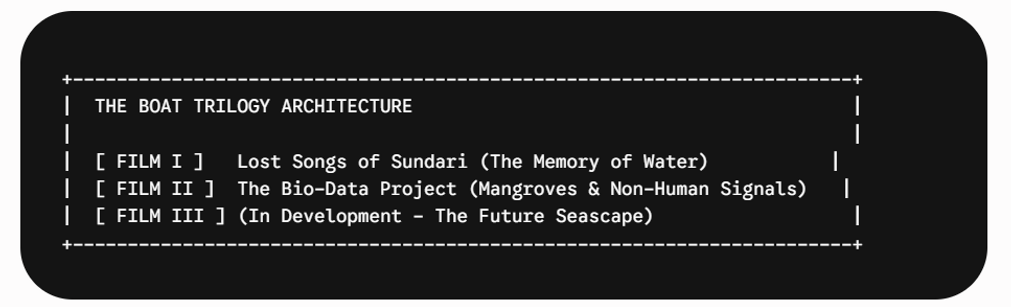
It is not an attempt to force nature to "speak" in human terms, but rather an invitation to tune our senses to frequencies we have long ignored.
Ultimately, Sundari—a word that translates to beauty—was made to leave audiences with a quiet, persistent question: In our rush to construct the future, what kinds of beauty are we willing to abandon, and do we truly have to? If the film prompts someone to look at their own changing riverbank or city street with a heightened sense of stewardship, then Sundari’s ferry has reached its destination.


Author Soultana Koumoutsi